


This designation is usually made with a board resolution and is not necessarily a cash segregation, meaning the business doesn’t physically set aside actual cash funds in separate accounts. Rather, the business simply reclassifies the funds within the equity section of the company’s balance sheet. The value of common and preferred shares appears in the shareholders’ equity section of the balance sheet. A deep understanding of how net income impacts retained earnings is essential for investors retained earnings statement and analysts to accurately assess a company’s financial strength and future potential. Ignoring this interconnectedness can lead to misguided decisions and missed opportunities for growth and sustainability. You can expand on the information listed in your statement of retained earnings if you want, such as par value of the stock, paid-in capital, and total shareholders’ equity.

What are the Benefits of the Statement of Retained Earnings?
It’s like having a secret stash that you can whip out when you want to invest in or boost your business, without the need for external funding or taking on more debt. It’s no wonder that savvy investors keep an eagle eye on this part of your balance sheet — it tells them whether the company is an able custodian of their investment. Lenders are interested in knowing the company’s ability to honor its debt obligations in balance sheet the future. Lenders want to lend to established and profitable companies that retain some of their reported earnings for future use. Even if the company is experiencing a slowdown in business activities, it can still make use of the retained earnings to pay down its debt obligations. The statement of retained earnings is mainly prepared for outside parties such as investors and lenders, since internal stakeholders can already access the retained earnings information.
Why is the Statement of Retained Earnings important in financial reporting?
Companies are required to report their financial statements to external parties, such as investors, creditors, and regulators, at the end of each reporting period. This includes the statement of retained earnings, which showcases the cumulative effect of a company’s net income, dividends, and other adjustments over a specific period. Retained earnings refer to the accumulated portion of a company’s profits that are not distributed as dividends to shareholders, and are instead reserved for reinvestment back into the business.
Step 3: Add Net Income (or Subtract Net Loss)
For finance teams looking to turn financial data into strategic insights, Abacum’s FP&A platform streamlines reporting and enhances collaboration. Our unified workspace connects your financial statements with operational metrics for a complete picture of business performance. Request a demo to see how Abacum can help your team move from reporting to strategic planning.
- Retained earnings are typically a component of the equity section on the balance sheet, and they can be affected by the net income reported in the income statement.
- Dividends represent a portion of the company’s profits distributed to shareholders and are subtracted from the retained earnings.
- In summary, the relationship between dividends and retained earnings is a fundamental aspect of the Statement of Retained Earnings.
- For instance, dividends paid are an important financing cash outflow for a corporation, but they are not an expense.
Retained earnings play a crucial role in a company’s financial health, representing the accumulated profits that are reinvested into the business rather than distributed as dividends. This financial metric provides insights into a company’s ability to generate profits over time and its commitment to growth and stability. Accurate tracking and reporting of retained earnings are essential for financial transparency and decision-making. Retained earnings refer to profits that a corporation keeps within its business instead of distributing them as dividends to shareholders. The statement of retained earnings is a financial document that details these changes over a specific period. By examining the statement, investors can gain insights into how a company intends to use its profits for future growth.

How to Calculate Retained Earnings for Your Business?
- Discover its benefits, examples, and Power BI tips to make smarter business decisions.
- If a company decides not to pay dividends, and instead keeps all of its profits for internal use, then the retained earnings balance increases by the full amount of net income, also called net profit.
- Net income is your company’s profit from a designated accounting period on the income statement.
- It connects the income statement and the balance sheet, showing how profits or losses impact the company’s equity.
- This statement provides valuable insight into a company’s financial health and its ability to reinvest profits for growth.
- Be aware, however, that the company will likely not be able to respond in a meaningful way.
Companies with consistent growth in retained earnings are often seen as financially stable and capable of funding expansion projects. Thus, this statement is a key component in evaluating a company’s overall performance and potential for future growth. A well-maintained retained earnings account attracts potential lenders, as it reflects the company’s ability to generate profits and maintain financial stability. In addition, it demonstrates a responsible approach towards debt management, ensuring that the company is less likely to default on loans. By subtracting the cash and stock dividends from the net income, the formula calculates the profits a company has retained at the end of the period.
Why Retained Earnings are Critical in Corporate Finance
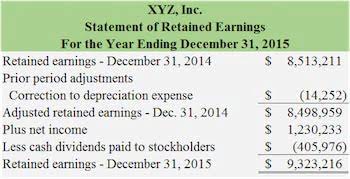
Reinvesting earnings back into the company can stimulate growth by boosting capital expenditures, working capital, and research and development. This can lead to increased sales, improved efficiency, and broader market reach. The key to a successful internal reinvestment strategy is to identify sectors within the business with the highest potential for growth and allocate resources accordingly. Once you have all of that information, you can prepare the statement of retained earnings by following the example above. When you’re through, the ending retained earnings should equal the retained earnings shown on your balance sheet. The retention ratio (also known as the plowback ratio) is the percentage of net profits that the business owners keep in the business as retained earnings.

Reconcile Financial Statements Thoroughly: Are You on Top of Your Finances?
During investor presentations or board meetings, retained earnings data provides context for discussing long-term initiatives. For example, a temporary reduction in dividends coupled with increasing retained earnings can be positioned as https://fariyasresorts.in/estimate-vs-invoice-what-are-the-major-differences/ an investment in future growth. This narrative helps align stakeholders around strategic vision and financial goals. This sample retained earnings statement should be prepared alongside your other financial statements.